
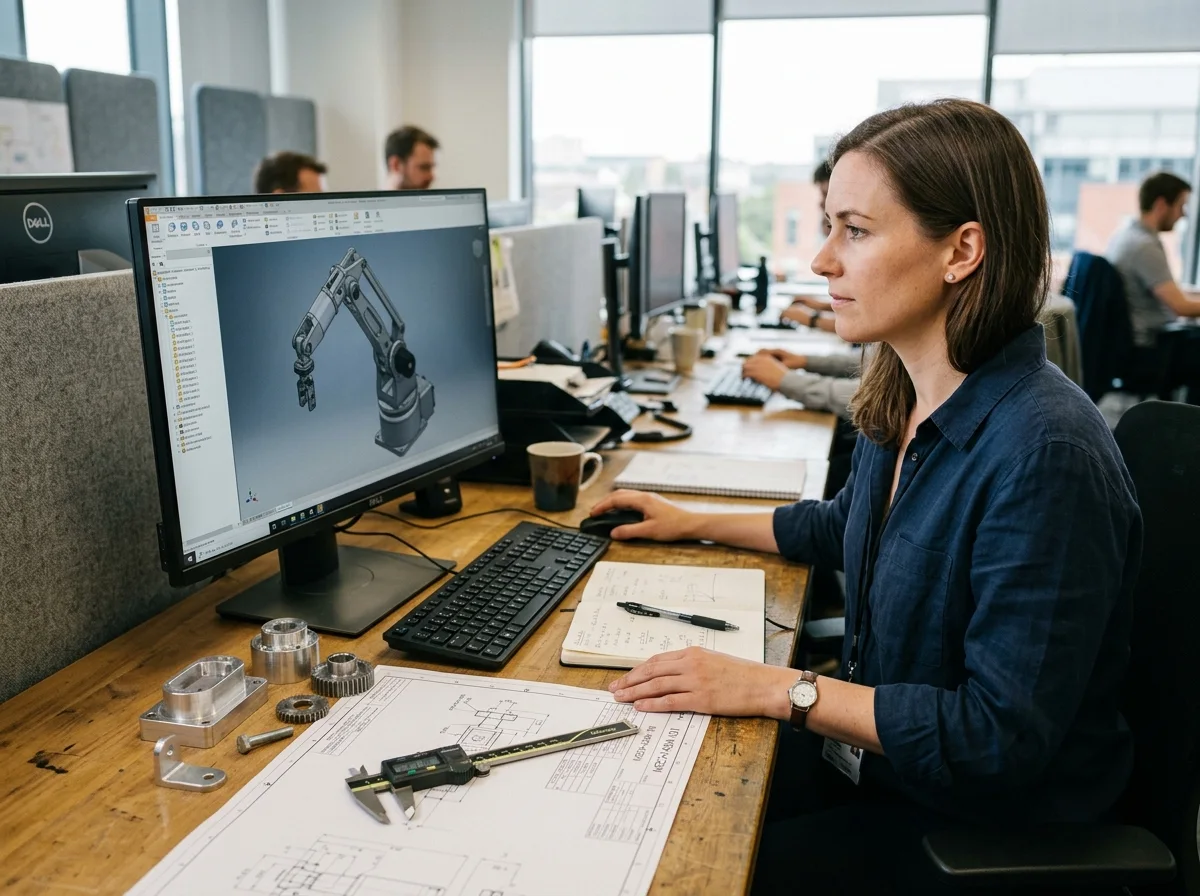
- AI in computer-aided design (CAD) does not replace mechanical engineers; it automates laborious rule verification, repetitive geometric feature extraction, and legacy conversion.
- Design for Manufacturability (DFM) automation prevents expensive tooling modifications by identifying machining collision and tolerance errors prior to factory tooling.
- Air-gapped and offline deployment is mandatory when handling proprietary defense, aerospace, or automotive CAD IP to prevent drawing leakage to public cloud LLMs.
Computer-Aided Design (CAD) files are the digital blueprint of physical manufacturing. However, massive engineering hours are consumed on tedious drafting cleanups, manual dimension audits, and tolerance stack checks. AI accelerates these workflows by automating rule-based computational geometry.
1. How Artificial Intelligence Assists CAD Workflows
Modern manufacturing AI applies deep geometric machine learning alongside deterministic rule engines:
- Geometric Feature Recognition: Automatically identifying through-holes, blind pockets, undercut chamfers, threads, and fillet radii directly from STEP, IGES, or native model files.
- Automated DFM Rule Checking: Instantly flagging deep pockets unreachable by standard CNC endmills, non-standard drill diameters, or thin wall thicknesses prone to warping during injection molding.
- Legacy 2D Drawing Vectorization: Converting scanned blue-prints and flat PDFs into structured, fully editable parametric 3D CAD models.
- Automated BOM Extraction: Instantly synthesizing bills of materials, hardware fastener counts, and raw material mass calculations from complex multi-part assemblies.
2. Core Manufacturing Applications
In precision manufacturing and production lines, AI algorithms deliver measurable cycle-time savings:
- Automated DFM Analysis: Catching manufacturing flaws before raw stock is clamped on CNC beds. See our DFM software solutions.
- Parametric Reverse Engineering: Converting high-density optical laser point clouds and mesh scans into clean NURBS surfaces. Read more on reverse engineering workflows.
- GD&T Verification: Comparing coordinate-measuring machine (CMM) coordinate inspection data against 2D drawing tolerances.
3. Why Air-Gapped and Offline Deployment is Non-Negotiable
CAD files constitute an enterprise's most confidential intellectual property. Uploading defense turbine blades, proprietary automotive chassis designs, or patented medical equipment to consumer public cloud AI APIs introduces severe compliance and espionage risks.
True industrial AI software must support 100% on-premises, air-gapped deployment. Models execute directly on local high-performance workstations or private intranet servers, ensuring not a single byte of geometry ever leaves the corporate perimeter.
4. Evaluation Checklist: Choosing the Right Tool
- Deployment Topology: Can the software operate completely offline without recurring internet license handshakes?
- Format Interoperability: Does it support native neutral formats (STEP, IGES, Parasolid, DXF) without corrupting topological manifoldness?
- Deterministic Explainability: Does the AI explain why a feature was flagged (e.g., "Wall thickness 1.1mm exceeds recommended plastic tooling limit of 2.5mm") rather than offering vague black-box suggestions?
- Validation on Real Geometry: Test the tool against your nastiest legacy files, not cherry-picked vendor marketing parts.
CADOPTIX AI was developed by Digiladder engineers specifically to deliver these capabilities with air-gapped security. The definitive test is to run it on your own CAD files — contact our team to coordinate a secure evaluation.