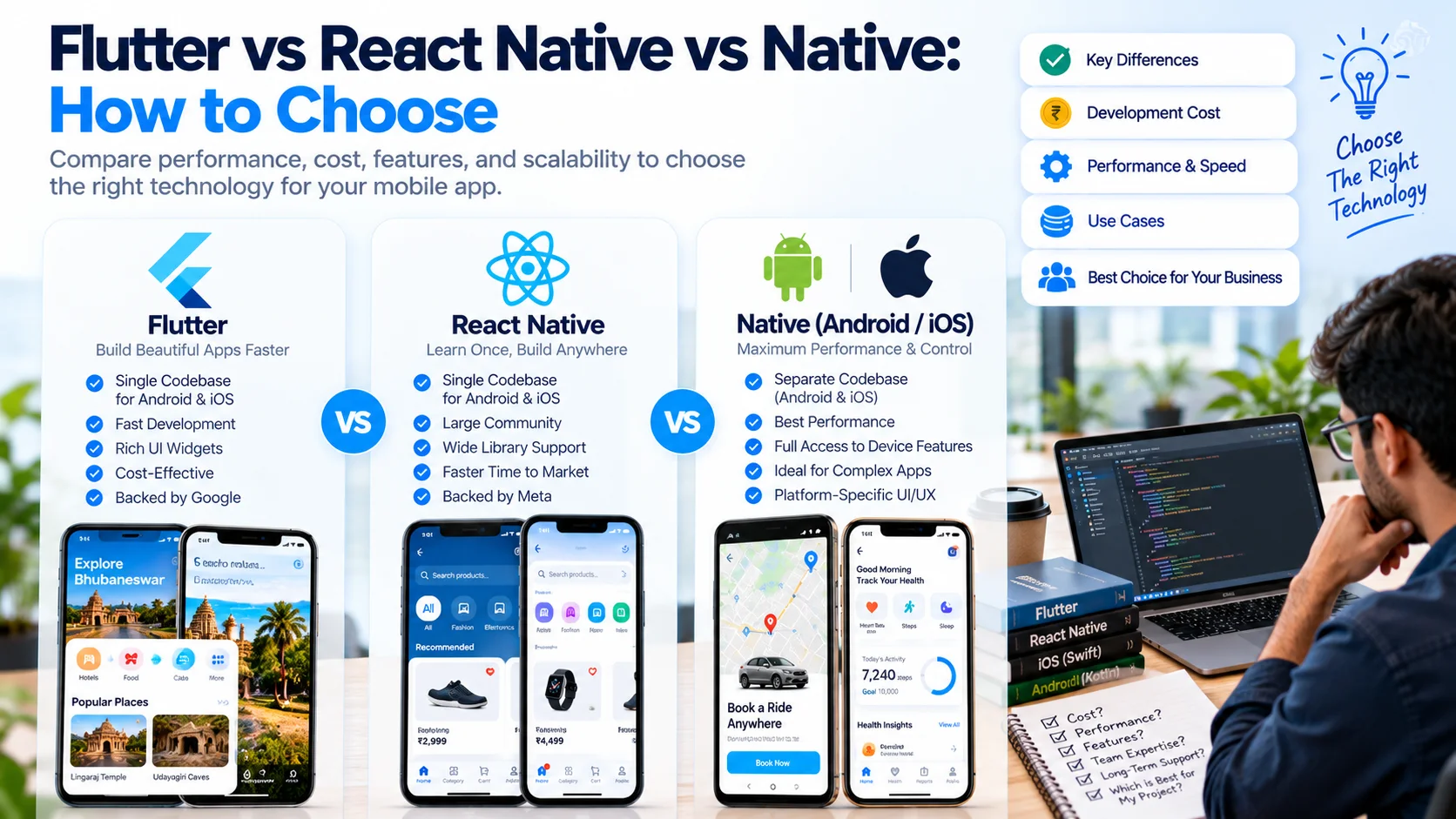
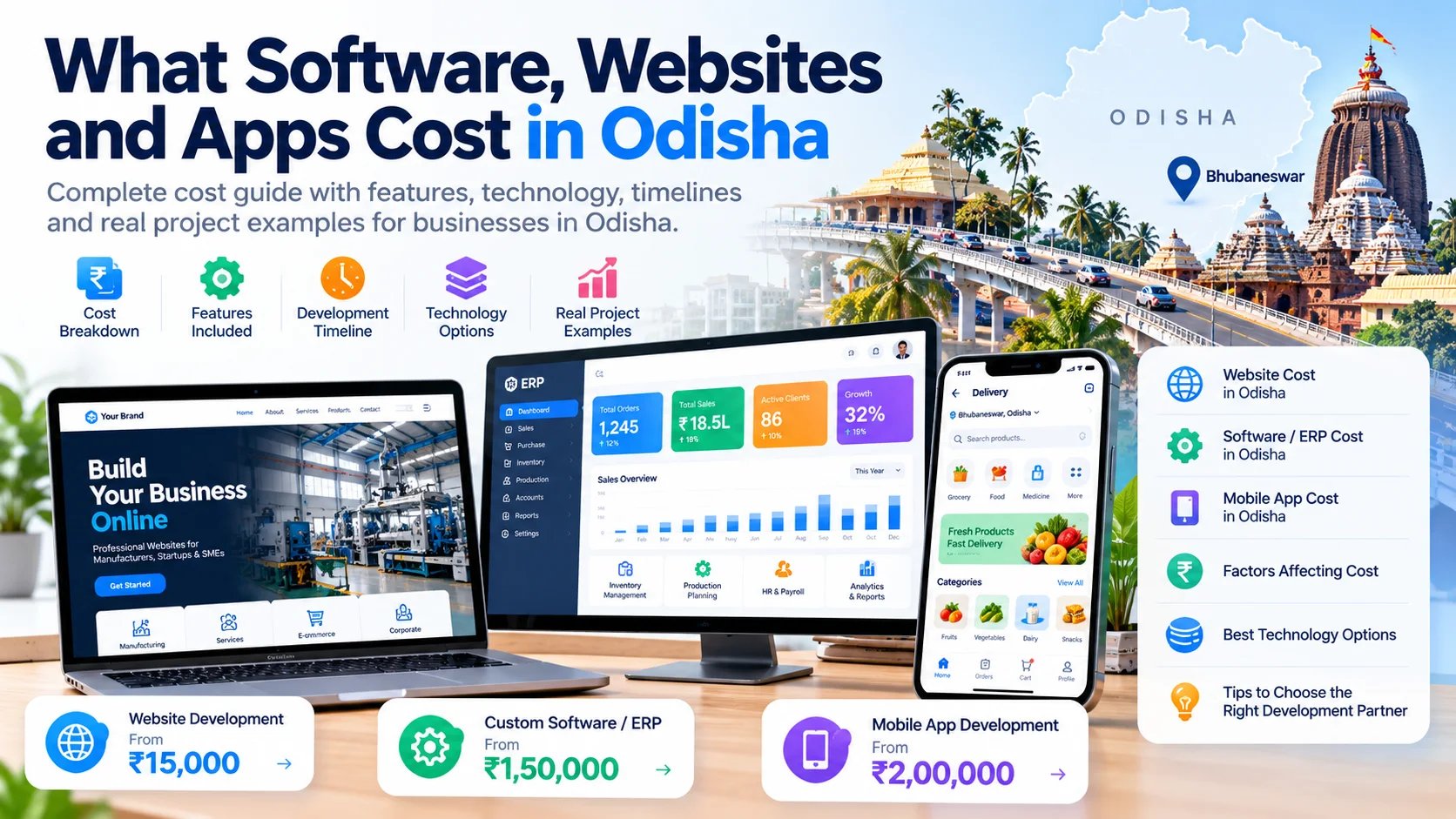
- There is no useful "price for a website" until scope, integrations and ownership are defined.
- Compare quotes on deliverables and milestones, not on the bottom line alone.
- Budget for recurring costs before you approve a build cost.
- Own your domain, accounts and source code from day one.
Buyers in Bhubaneswar and across Odisha ask us the same question: what should this cost? The honest answer is that the number follows the scope, and scope is the part most quotes leave undefined. This guide deliberately avoids rupee figures. Instead it breaks down what actually moves a quote up or down, and how to compare two proposals that look nothing alike.
Rule one: price follows scope
Two vendors can quote for "a website" and mean completely different things. One is building five brochure pages from a template. The other is building a product catalogue with search, enquiry routing, quotation workflows and integration into your existing accounting system. Until those differences are written down, comparing the numbers is meaningless.
So start with a written scope: the pages or screens, the workflows, the integrations, who supplies the content, and who owns the result. Everything else in this article hangs off that document.
Websites: the four scope tiers
- Brochure site. A defined set of pages, a contact form, basic on-page SEO, a content-managed way to edit text. The cost driver is design and content preparation, not technology.
- Lead generation site. Adds service or product architecture, landing pages, structured data, analytics, conversion tracking and enquiry routing. The cost driver is content depth and measurement, plus how many templates are genuinely different.
- E-commerce. Product catalogue, variants, payments, shipping and tax rules, order notifications, returns, and synchronisation with stock or accounting. The cost driver is integration and the exception cases in your commercial rules.
- Web application. Logins, roles, dashboards, workflows, reporting. At this point it is software with a browser interface, and it should be estimated like software.
Mobile apps: three honest tiers
- Validation build. A focused app with a small number of screens, one core flow and a simple backend, intended to prove demand. Smallest scope that can be released properly.
- Integrated business app. Accounts, notifications, payments, offline behaviour, an admin console and integration with your existing systems. This is where most serious projects sit, and where backend work usually exceeds app work.
- Platform. Multiple user types, marketplace or multi-tenant logic, analytics, compliance requirements and a roadmap that keeps going after launch.
Custom software and internal tools
Internal systems are usually justified by removing manual work, so the estimate must include more than development: process discovery, data migration from spreadsheets, integration with what you already run, user roles, reporting, training and a support arrangement. Skipping discovery is the classic way to fund a system nobody uses.
The cost drivers, in order of impact
- Number of genuinely different templates or screens, not the total number of pages.
- Custom logic: pricing rules, permissions, approval chains, scheduling.
- Integrations and the readiness of the other system's API or export.
- Content and data migration, including scanning, cleanup and re-keying.
- Backend and administration, which grows with every workflow added.
- Design depth: a new visual identity and custom illustrations cost less than they used to, but they are still effort.
- Quality assurance across devices, browsers and network conditions.
- Security and compliance requirements specific to your sector.
- Deadline pressure, where parallel work or overtime is required.
- Number of stakeholders and review cycles, which quietly consumes weeks.
Recurring costs buyers routinely forget
- Domain registration and renewal, plus business email.
- Hosting sized for real traffic, and the SSL certificate if it is not bundled.
- Third-party services: payment gateway charges, SMS or WhatsApp messaging, maps, transactional email, e-signature.
- App store developer accounts, and the platform fees attached to digital sales.
- Operating system releases and store policy changes, which force periodic updates.
- Content, photography and ongoing SEO or advertising work.
- Backups, monitoring and someone accountable for incidents.
None of these are optional in practice. A project that looks affordable to build can be uncomfortable to own.
Hidden costs worth asking about in writing
- What happens when we need a change after launch, and what is the rate?
- Is a support window included, and what does it cover?
- Are licences or premium plugins passed through at cost?
- Is content migration included, or is that our team's job?
- Who pays for third-party fees during the build?
- What is the process, and the cost, if we leave?
Comparing quotes fairly
Ask every vendor for the same five things: a written scope, a deliverables list, a milestone plan, an ownership statement, and a post-launch support definition. Then compare those, not the totals. A cheaper quote that excludes content migration, tracking or training is not cheaper — it is incomplete.
Payments, milestones and ownership
A milestone structure protects both sides: an initial payment against mobilisation and discovery, payments against demonstrable progress, and a final payment on handover. Insist that domains, hosting accounts, store accounts, analytics and source code are registered in your organisation's name, and that the contract states that copyright in custom work transfers to you on payment. Vendors who resist this are telling you something useful.
Local vendor or remote vendor
A local partner in Bhubaneswar brings onsite working sessions, faster escalation and easier accountability when something goes wrong. A remote partner may offer breadth or a different price structure. The deciding factors are usually how much discovery your project needs, how critical the system is to daily operations, and whether the working hours overlap enough for real collaboration.
Reducing cost without wrecking the result
- Phase the work: release the core flow first, then extend once it is earning.
- Reuse a platform where your requirements are genuinely standard, and build custom only where they are not.
- Prepare content and data early; waiting on content is the most common cause of overrun.
- Decide who has final approval before the build starts.
- Reduce the number of templates: consistency is cheaper than variety.
What to prepare before you ask for quotes
A one-page brief covering purpose, audience, must-have features, systems to integrate with, content availability, timeline and budget range will improve every quote you receive. Buyers who provide it get proposals that are comparable, and vendors stop guessing.
If you would like that conversation with engineers rather than salespeople, look at our website development, mobile app development and digital marketing practices, review recent project work, or send us your brief and we will respond with a written scope and a milestone plan.